Portfolio
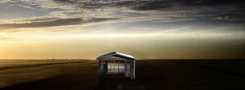
NulNAP – walking an imaginary coastline
Imagine: you’re walking through an open polder landscape, along a dike, under a gray sky. With you walks not a friend or colleague, but an AI companion—an artificial intelligence system that thinks along with you, asks questions, and contradicts you. And beneath your feet lies the landscape itself, silent yet expressive, with its own shapes, scents, memories. Who or what is actually observing here?
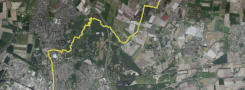
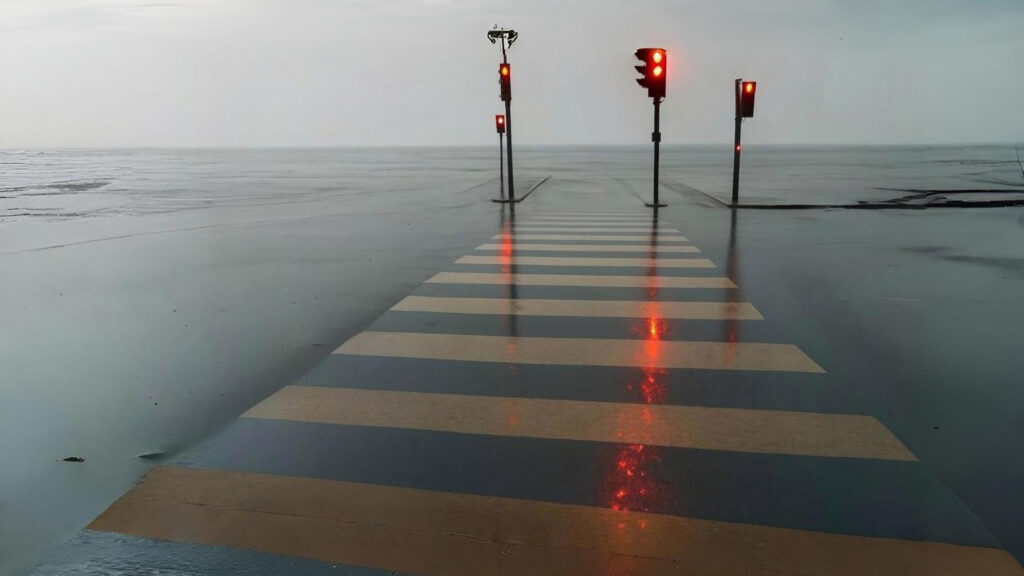
I have walked the Dutch Zero NAP line for over a year now. This imaginary coastline marks sea level in the Netherlands — a line that becomes increasingly loaded with meaning as climate change reshapes our relationship with water. But walking this line alone felt incomplete. The landscape holds so much history, so many layers of human intervention, that I needed another voice to help me see what I was missing.[more]

[click to listen to a walker-AI-landscape conversation]]
Eemland – getting close to a polder
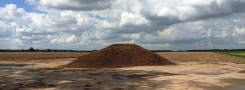
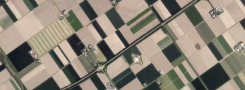
As an artist and researcher, I’ve developed a complex, multi-layered relationship with the Eemland polder. My work weaves together diverse perspectives that, at first glance, seem contradictory, but in reality create a rich and nuanced picture of this unique area. Eemland appears open and empty, yet it is one of the most intensely managed landscapes in the Netherlands. It feels timeless, almost inert, while every meter of it is the result of continuous intervention, calculation, and care.
Rather than aiming to explain Eemland, my work stays with its tensions: between emptiness and control, visibility and neglect, care and exploitation. The polder becomes not an object of representation, but a collaborator in thinking—one that resists easy narratives and rewards sustained, patient attention. [more]
More work on landscape
Much of my work starts from a simple question: what does it mean to look at a landscape that has already been thoroughly shaped, named, measured, and managed? In the Netherlands, landscape is rarely neutral. It is engineered, regulated, and culturally rehearsed. The works brought together here approach this condition indirectly—through language, photography, and moments of attentiveness.
Together, the projects in this section form a loose archive of encounters with landscape: sometimes awkward, occasionally playful, and always aware that in a place like the Netherlands, even emptiness is the result of design.
Games outdoors
My games are invitations rather than instructions. They begin with simple rules, materials, or gestures, and are designed to be taken over, expanded, and reinterpreted by others. In projects such as Circle Game at the Southbank Centre and Galaxy, a minimal action—drawing circles, following a pattern, entering a shared space—becomes a catalyst for collective behavior. What interests me is not the game as an object, but the moment when participation tips from individual curiosity into shared momentum.
In Action Weaving and related projects, play becomes a way to temporarily suspend social scripts. Children engage instinctively, but it is often adults who surprise me most—once they allow themselves to step out of line. These works take play seriously—not as escapism, but as a method for testing how collective action, trust, and imagination can briefly reconfigure the world.
Games indoors
My indoor games explore what happens when everyday patterns of play are reframed through technology and spatial reconfiguration. Familiar activities—table tennis, walking, handling objects—are placed within setups that add layers of observation: cameras, screens, viewpoints from above. These games operate simultaneously on multiple levels. Participants are engaged in the immediacy of play, while at the same time becoming aware of themselves as images, as data, as bodies seen from elsewhere. The installations invite movement, but also reflection: seeing and being seen unfold at once.
Underlying these projects is a broader question about subjectivity in technologically mediated environments. When bodies are continuously represented—on screens, in recordings, online—does the self begin to form from the outside in? These games treat play as a research tool: a way to explore how attention, embodiment, and identity are reconfigured when physical space and virtual space compete for presence.
Performances
My performances are inquiry-driven actions in public space. They often begin with a simple proposition—a question, a statement, a choice—and unfold through encounters with passers-by. Whether selling contradictory buttons on the day of a royal inauguration, or writing a question on the pavement in front of a museum, the work is not about provocation for its own sake, but about testing how ideas circulate once they leave the studio. Conversation, hesitation, humor, and disagreement are not by-products of the work; they are the work.
Underlying these performances is a long-standing fascination with how we come to know what we know. Words, numbers, images, beliefs—each claims authority in different contexts, and each shapes how certainty is produced and maintained. Performance allows these modes to collide in real time. Influenced by artists such as Carsten Höller and his commitment to doubt and perplexity, my actions do not seek to offer answers, but to unsettle them.
Papers
Alongside my artistic practice, writing has become an increasingly important part of my work. I discovered—somewhat to my own surprise—that I genuinely enjoy the slow, careful knitting together of ideas, and the way arguments are woven into the broader fabric of academic discourse. This was not something I anticipated when I started my PhD.
That changed in January 2025, when my supervisor challenged me to write a paper on walking with AI in the space of just a few weeks. What followed was an intense period of focus: the paper was written, submitted, and accepted for presentation at ISEA2025. This experience marked a turning point. Writing no longer felt like documentation after the fact, but as a practice in its own right—one that resonates strongly with how I think and work as an artist-researcher.
Since then, this trajectory has continued. A second paper was written and accepted for POM Perth and the Technoetic Arts Journal (forthcoming). I am currently working on a third contribution: an online exposition developed for the Research Catalogue, conceived as a web-based format rather than a traditional article. Together, these papers form a growing body of written work that runs parallel to, and in dialogue with, my artistic practice.